


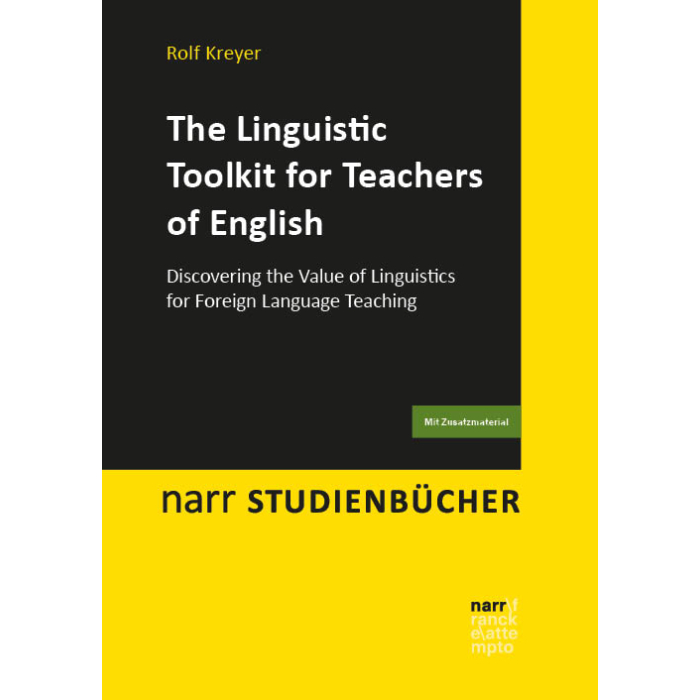
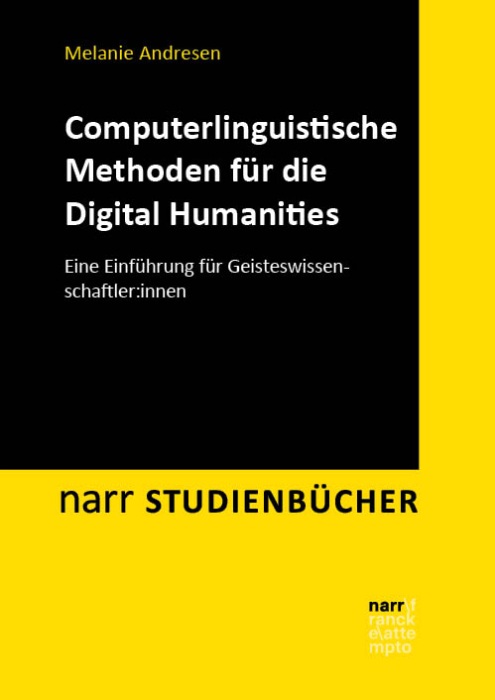
 As you might imagine from its title, this book is a handbook for practising teachers and students who intend working in the field of language teaching. The author, Rolf Kreyer, is a professor of modern English linguistics and works at the University of Marburg in Germany. It was students of his who inspired him to write the work.
Unlike guides on practical teaching techniques, this book aims to provide its readers with a thorough grounding in key aspects of modern linguistics that are relevant to teaching and learning a second language. It shows you how this theoretical foundation can be used effectively to teach a foreign language to learners (hence its subtitle, "Discovering the value of linguistics for foreign language teaching").
Section 2, "Errors and why they are a good thing", is about making mistakes in a foreign language and about the various stages in mastering it (the learner's "interlanguage"). Sections 3 and 4 are on sounds, pronunciation and comparative phonetics ("What are you sinking about?”). The author even goes into the rarely mentioned subject of "weak" forms of sounds (like the "e" in "the", as opposed to the clearer/stronger "e" in "empty" or "elephant"). Such "weak" sounds often occur in English, but many German learners are not aware of them. Sections 5 and 6 are on words, the mental lexicon and interrelatedness. Sections 7 and 8 are to do with corpus linguistics and how corpora (collections of texts) can be used in the classroom to show how words are commonly used or grouped together (collocations). Sections 9, 10 and 11 are about text work, the differences between spoken and written English, and how to express politeness. Finally, sections 12 and 13 focus on communicating, on the importance of background knowledge and on how information is packaged in different ways, which are not always easy to "unpack" correctly, even for native speakers.
It's quite an achievement to compress these aspects of linguistics into 300 pages, but Prof. Kreyer has done a good job of it in my opinion. On top of that, he has included various examples, diagrams and tables to help readers grasp the concepts better and has incorporated practical exercises in each chapter as well.
Tips for further reading are provided at the end of each chapter for those who want to find out more about the subjects he discusses. All the works he refers to are listed in the bibliography near the end of the book, followed by a glossary of technical terms and an index with page references to help readers find the sections they need quickly.
This is a well-designed book that is written in a readily accessible style, making it a good read for any language teacher, regardless of what language they choose to focus on. Some sections are easier to follow than others because they are relatively technical, but the contents are always outlined clearly and the short exercises make you think about the topics and apply what you have just learnt. Some supplementary material is provided for free on the publisher's website, which can be accessed by keying in a code inside the book cover.
My only gripes about this textbook are that it would have been good to get the whole book proof-read by a native speaker of English before it went to print (I would gladly have done it as I'm a language teacher myself!). Besides that, there's no mention of translation in the table of contents or the index, even though it's an age-old skill and something every learner does automatically. How we translate words, sentences and ideas into another language is a fascinating subject in itself. Translation techniques can be taught explicitly in the classroom to help students do it better themselves. After all, translation is a cognitive process and therefore part of psycholinguistics.
Click on this link to the publisher's website to view the table of contents online. (I particularly liked section 4.3, entitled "France is bacon"! It's about how words are linked together in spoken English.)
It's obtainable directly from the publisher or through your local bookshop.
Publisher/year: narr/francke/attempto, 2023
ISBN: 978-3-8233-8611-7 (printed version), 978-3-8233-9611-8 (ePDF)
Hope you enjoy the read as much as I did.
Carl
 While I was studying Applied Linguistics at university in Hamburg back in the 1990s, the academic subject of computer linguistics was just developing. I touched on the interdisciplinary field of computing and foreign language learning and teaching in some of my courses and later went on to write my Master's thesis about acquiring foreign-language vocabulary using software packages currently on the German market.
 A few months back, I started finding out more about online learning platforms, partly out of curiosity and partly because I thought I might need to know how to use Moodle in my own language teaching one day.
 Hey, I've just got my first Moodle badge!
 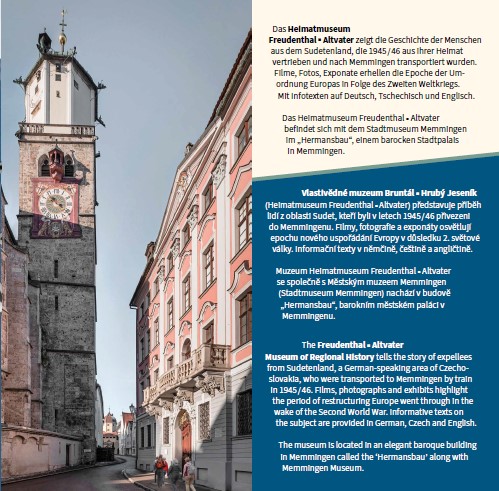 Am Sonntag, den 7. Mai 2023 wurde das Heimatmuseum in Memmingen nach umfangreicher Renovierung wieder eröffnet. Die Ausstellung über sudetendeutsche Aussiedler (= Flüchtlinge/Vertriebene), die am Ende des Zweiten Weltkrieges von Tschechien nach Memmingen gekommen sind und dort ein neues Leben für sich aufbauen mussten, wurde von der Museumspädagogin
 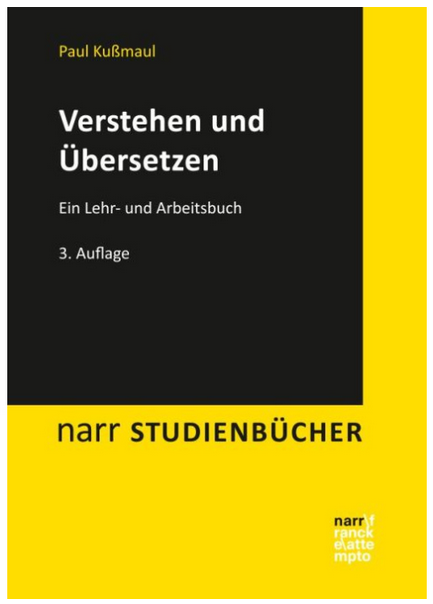 Here are a few more points he covers: how close should a translation be? (chap. 3), the need to differentiate (3.3), how to go about researching a term or subject (4.1), linguistic v encyclopaedic knowledge, expanding your vocabulary by learning new meanings of existing words, going beyond dictionaries when their entries fail to help (4.2), referring to online resources (IATE, Wikipedia, Google, etc.) and analysing texts properly to deduce the right meaning of a word in its context (dictionaries don't always offer the right answer!).
 Do you happen to know what the difference is between "recto" and "verso"? How is a "folio" different to a "page"? What exactly is a "codex" and how does it relate to a printed book?
 If you have a




Comments