


Verstehen und Übersetzen
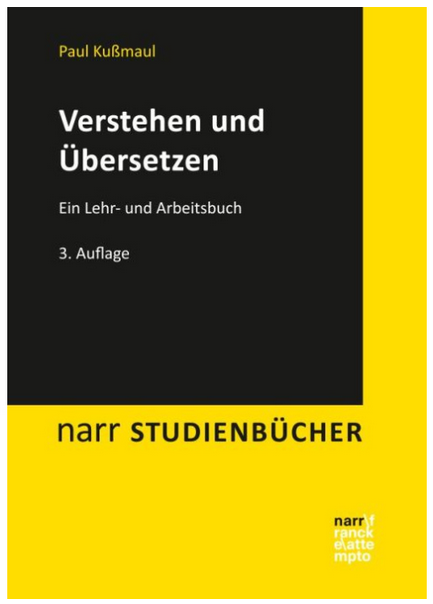
by Paul Kußmaul
This work is a textbook for students of translation studies. It stands out from the crowd because of the way it's written: it's clear and practical, and doesn't get overly abstract when it addresses theoretical aspects of cognition and semantics. The author taught translators at the University of Mainz in Germersheim, Germany, for many years and often draws on what he experienced in his classes, introducing questions the students had and explaining how they tackled linguistic problems encountered during translation exercises.
The book is divided into eight chapters and spans 230 pages in its third, revised edition (from 2015). The first edition of it appeared in 2007, so it seems to be popular (and justifiably so in my opinion). Each chapter is followed by a short section with exercises to practise what has just been covered in the book, and some suggested answers can be found at the back, which is handy.
I like the variety of topics in this book. Initially, the author discusses lexical "false friends", ambiguity and knowing which word or meaning to pick in a dictionary (is a brush a "Pinsel" or a "Bürste" in German?). He looks at semantic prototypes and "framing" (1.5) in connection with mental images of words and situations to be translated and then covers words that are "hard to translate" (1.7).
Some of the examples he picks are taken from questionnaires in English that were translated for mass surveys in various European countries (ISSP surveys). These often contain references to culture-specific terms, such as "National Insurance Contributions", but even words like "local" or "government" (p. 88) can turn out to be tricky to translate and call for careful reflection (pp. 37, 38). One of the key points Kußmaul makes is that words don't live in isolation, but in a specific cultural setting (2.1), which a translator also needs to bear in mind.
 Here are a few more points he covers: how close should a translation be? (chap. 3), the need to differentiate (3.3), how to go about researching a term or subject (4.1), linguistic v encyclopaedic knowledge, expanding your vocabulary by learning new meanings of existing words, going beyond dictionaries when their entries fail to help (4.2), referring to online resources (IATE, Wikipedia, Google, etc.) and analysing texts properly to deduce the right meaning of a word in its context (dictionaries don't always offer the right answer!).
In the second half of the textbook, the author looks at cognitive translation processes (chap. 5), creativity in translation (6), visualising and scenes (7), and problem-solving as a translator, along with various practical strategies and techniques (8) translators can use.
In a nutshell, then, "Verstehen und Übersetzen" is a useful, hands-on textbook that is well worth reading. And astonishingly for a German textbook, it's actually easy to follow.
Link to the e-book on the publisher's website (Narr Verlag). You can also order a printed copy of the book online or from any bookshop.
Best,
Carl
Thursday, 3 February 2022
 Book review: 'Alltag in Großbritannien. Leben und arbeiten in England, Schottland und Wales' by Katrin Koll Prakoonwit, Conbook Verlag, 2013
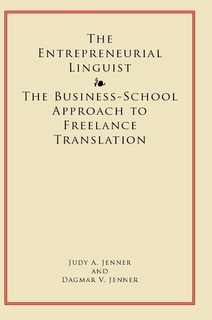 Although "The Entrepreneurial Linguist" by linguists Judy and Dagmar Jenner first appeared on the book market in 2010, I have to admit it took me a while to get round to buying a copy and reading it myself. Fortunately, many of the subjects the book covers are still applicable to freelance translation work today – as the title implies, it's mostly about setting up and running a translation business long-term rather than using specific software tools to get your work done, although these are also discussed briefly.
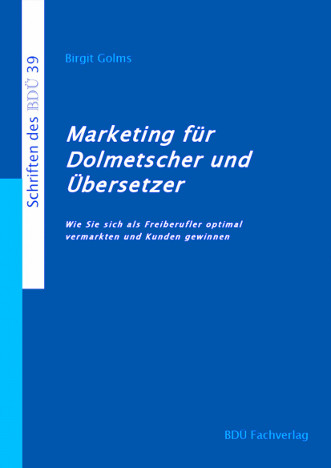 As the German title says, this practical little book is a basic guide on marketing and is specifically tailored to the needs of translators and interpreters. Although it's written for speakers of German, I expect much of what it has to say is equally applicable to other cultures as well, although marketing styles no doubt vary internationally.


Comments