


The other day I happened to stumble across a job advert by SDL plc, a well-known producer of software tools for translators, one of which I reviewed here briefly last autumn. The position was being advertised via monster.de, the big job portal on the internet, and looked as though it was in nearby Munich, which was why it initially caught my attention. It turned out it was actually an internship as an English to German translator. On closer reading, I found that the post was over in Sheffield (in the UK) and that SDL expects the person who is fortunate enough to get the job to work for what I would call peanuts – the National Minimum Wage in Britain, a stunning £6.50 an hour (7.85 euros at today's exchange rate).
Here's the top half of the ad, showing an appealing picture of a young team of professionals around a laptop, presumably to put you in an enthusiastic mood:

Looking at the job description, it sounds like an interesting position for a qualified translator. You would be working with a variety of CAT tools (obviously, since that's what SDL produces) and doing translating and editing work that can be demanding (post-editing machine-translated texts). You'd also have a degree of responsibility because you'd be checking software to find any mistakes or problems with it, testing websites (presumably how well they work) and doing terminological work, which means building up and possibly verifying and editing terms in a terminology database, no doubt for other members of staff (= translators) to use.
You need an educational background in translation or terminology for this job, as SDL specifically requests, and very good skills in two languages as well:
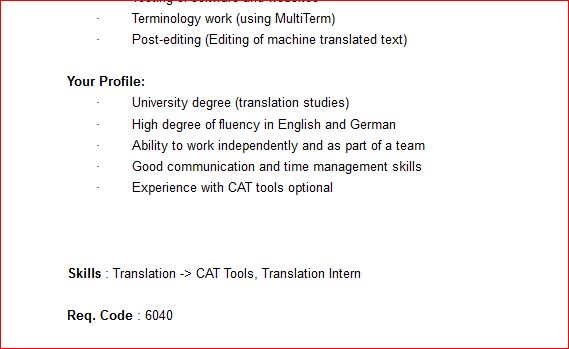
What do you think about this advertisement? My first reaction was one of disbelief; I asked myself why anyone with suitable qualifications should want to undertake work like this for a pittance? After all, it's a full-time position, even if it's only for six months (apparently with no option of being taken on properly afterwards).
Is it reasonable for an employer to expect this kind of work to be done by an intern, do you think? I could understand them offering the internship for a shorter period, say three months, but six seems a bit steep to me under these circumstances. On the other hand, it's become quite common for young people, including recent university graduates, to try and get some work experience in business fields that interest them even if it means them not being paid anything at all – it's the experience that counts for them rather than their earnings. (Think of the media, for example – TV and advertising.) In that respect, this particular position could be regarded as a particularly attractive one since you'd be getting paid all the time in addition to being given the opportunity to learn a lot about modern translation technology.
Still, I must say I find it unsettling to see low-paid positions being advertised that require skills that not everybody happens to have. Although the person's manpower would be tied up for half a year and the work they'd do would benefit the employer's own web marketing, they'd only be offered a token salary. Something's not quite right there, is it?
Carl
 If you are a translator who uses one of SDL's computer-assisted translation (CAT) tools (e.g. Trados® 2007 or one of the newer versions of Trados® Studio (2009 or 2011), you will probably already have heard about the firm's relatively new software-development platform
  As an aside, I noticed that some of these optional plug-ins are actually included in memoQ's functionality; they are there if you want to use them and just have to be activated by ticking a check box - there's no need to download and install them, let alone pay for them. Instruction manuals for memoQ and other CAT tools made by Kilgray are available from
  Still, a number of the Studio and MultiTerm plug-ins and apps do look interesting and provide enhancements that are still lacking in memoQ. In the course of time, however, memoQ users may find that a growing number of these are being offered on the Language Terminal. Let's wait and see how it evolves...


Comments